








The best LaunchDarkly alternatives & competitors, compared


Contents
LaunchDarkly is a solid feature management platform – mature, enterprise-grade, and trusted by large engineering orgs; but it's not the right tool for everyone. They've recently acquired Highlight.io, a session replay tool, which expanded their observability capabilities.
This guide compares the best LaunchDarkly alternatives across different use cases – from all-in-one platforms to focused feature flag tools – so you can find the right fit.
1. PostHog
- Founded: 2020
- Similar to: LaunchDarkly, Statsig
- Typical users: Engineers and product teams
- Typical customers: Mid-size B2Bs and startups
What is PostHog?
PostHog (that's us 👋) is a developer platform combining feature flags, experimentation, error tracking, web analytics, product analytics, session replay, user surveys, and more into one product.
This means it's not only an alternative to LaunchDarkly but also tools like Mixpanel, Hotjar, and Sentry.
Typical PostHog users are engineering, growth, and product teams at high-growth startups and scale-ups, particularly B2B companies. They rely on PostHog to provide all the tools they need to understand users, test new features, and gather feedback.
Key features
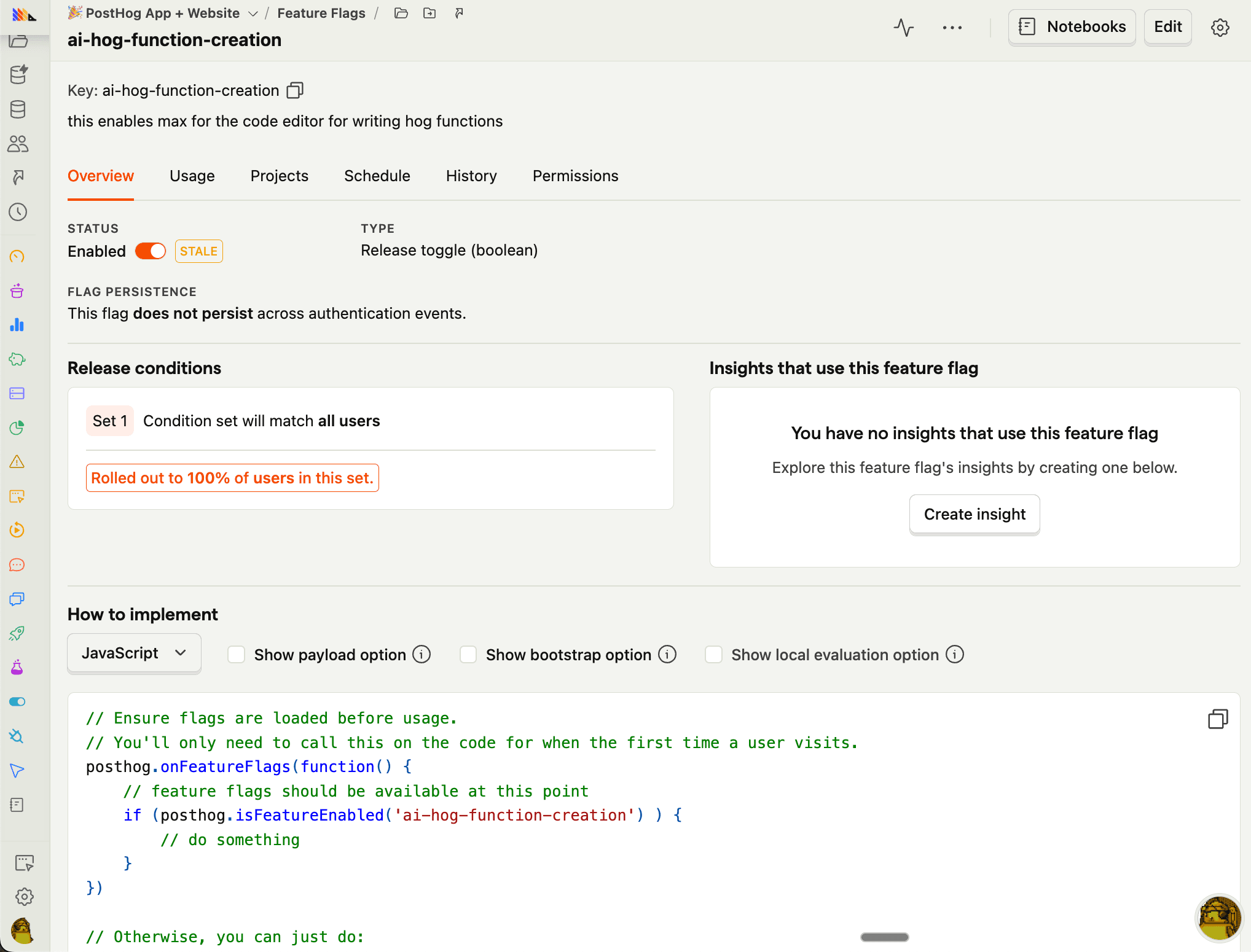
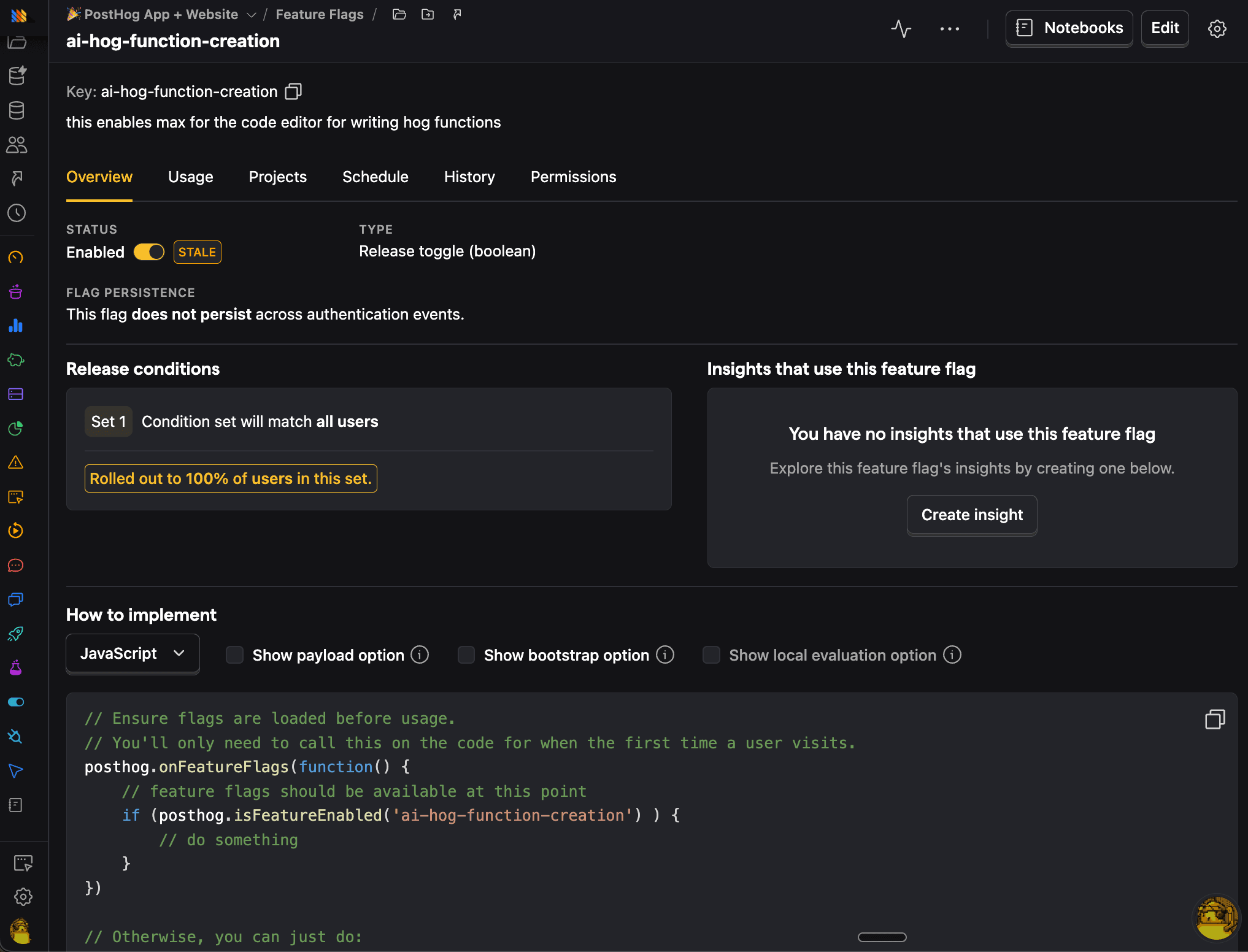
Feature flags: Safely rollout features to percentages and cohorts of users with local evaluation (for faster performance), JSON payloads, and instant rollbacks.
Experimentation: Test multiple variants, primary and secondary metrics, with Bayesian or Frequentist analysis. Automatically calculate test duration, sample size, and statistical significance.
Product analytics: Funnels, user paths, retention analysis, custom trends, and dynamic user cohorts. Also supports SQL insights for power users.
Error tracking: Capture, group, and triage errors directly in PostHog. Linked to session replays and feature flags so you can see exactly what a user experienced when an error occurred.
Session replays: Get a playback of a user's session on your site or mobile app. Includes event timelines, console logs, network activity, and 90-day data retention.
Data warehouse and CDP: Import data from external sources – Stripe, HubSpot, Postgres, and more – and use it directly in experiments and analytics. Send PostHog data anywhere with the built-in CDP.
How does PostHog compare to LaunchDarkly?
The core features for feature flags and experimentation are similar between the two. The big difference is that PostHog is free, open-source, and self-serve, while LaunchDarkly has automations.
Features like integrations, API controls, and reusable segments are only available on LaunchDarkly's Pro plan, but are available for free on PostHog.
Main differences between PostHog and LaunchDarkly
- PostHog is an all-in-one platform – product analytics, session replay, error tracking, surveys, LLM analytics, and a data warehouse are natively integrated with flags and experiments. LaunchDarkly now offers session replay, heatmaps, error monitoring, logs, and traces, but these are oriented around release monitoring rather than a full tool suite.
- PostHog is open source and self-serve with transparent usage-based pricing. LaunchDarkly's advanced features require a sales process and enterprise contract.
- LaunchDarkly has deeper release governance tooling – approval workflows, automated rollback, flag scheduling, and SCIM provisioning.
- LaunchDarkly is more expensive for smaller teams; its per-service-connection pricing scales differently than PostHog's usage-based model.
Main similarities between PostHog and LaunchDarkly
- Both offer feature flags with local evaluation, multivariate flags, JSON payloads, percentage rollouts, and targeting by user properties.
- Both support A/B testing with statistical significance calculations and multiple metrics.
- Both have SDKs for all major languages and frameworks.
- Both support multi-environment flag management and audit logs.
Why do companies use PostHog?
According to reviews on G2, companies use PostHog because:
It replaces multiple tools: PostHog can replace LaunchDarkly (feature flags and A/B testing), Mixpanel (analytics), and Userpilot (feedback and surveys), and more. This simplifies workflows and ensures all product is in one place.
Pricing is transparent and scalable: Reviewers appreciate how PostHog's pricing scales as they grow. There's a generous free tier they can use forever. Companies eligible for PostHog for Startups also get $50k in additional free credits.
They need a complete picture of users: PostHog includes every tool necessary to understand users and improve products. This means creating funnels to track conversion, watching replays to see where users get stuck, testing solutions with A/B tests, and gathering feedback with user surveys.
Bottom line
Being free, self-serve, and sharing many of the same features, PostHog is a great alternative to LaunchDarkly. This is especially true for startups and scale-ups looking for all the dev tools they need in one.


Install PostHog with one command
Paste this into your terminal and make AI do all the work.

2. Statsig
- Founded: 2021
- Similar to: DevCycle, PostHog
- Typical users: Engineering and DevOps teams
- Typical customers: Engineering-focused B2B companies

What is Statsig?
Statsig provides tools like feature flags, experimentation, and analytics to help companies build better products. Teams use Statsig to take risk out of releases, experiment with new features, and monitor changes.
It also includes a warehouse-native mode to connect directly and utilize your data warehouse, such as Snowflake.
Key features
Feature flags: Take the risk out of releases with targeted feature flag rollouts.
Experimentation: Run product experiments and compute results with their advanced statistical analysis.
Analytics: Provides a single location for your metrics. Enables users to dive deeper into them with trends, bar charts, and retention analysis.
Data warehouse: Use Statsig with your existing data in your own warehouse. Generate insights and calculate impact of changes using existing data.
How does Statsig compare to LaunchDarkly?
Statsig has a stronger focus on experimentation and broader built-in analytics than LaunchDarkly, plus a warehouse-native mode that works across Snowflake, BigQuery, and Databricks. LaunchDarkly goes deeper on release governance and now includes observability features.
Main differences between Statsig and LaunchDarkly
- Statsig's experimentation engine is a core focus with advanced statistics (CUPED, sequential testing, AI-powered summaries). LaunchDarkly's experimentation is solid but secondary to its release governance tooling.
- LaunchDarkly has deeper release governance and offers automated rollback via its Guardian plan. Statsig also has features like approval workflows, RBAC, and SCIM provisioning, but lacks the automated rollback.
- Statsig's warehouse-native mode works with Snowflake, BigQuery, and Databricks. LaunchDarkly's Data Export also supports all four major warehouses (Snowflake, BigQuery, Databricks, Redshift), though its deeper warehouse-native experimentation (running analysis inside the warehouse) is currently Snowflake-focused.
Main similarities between Statsig and LaunchDarkly
- Both support feature flags with percentage rollouts, user targeting, and multi-environment management.
- Both offer A/B testing with statistical significance and multiple metric support.
- Both have broad SDK coverage across web, mobile, and backend languages.
- Both now include product analytics and session replay.
Why do companies use Statsig?
According to G2, users are big fans of Statsig because:
Experiments-focused: Statsig provides all the tools to run successful experiments. Reviewers write this enables them to ship faster and create an experimentation mindset.
Responsiveness: The Statsig team is responsive to user issues and concerns. Reviewers appreciate how helpful support is.
Documentation: Thanks to the solid documentation of SDKs and features, in combination with a simple UX, reviewers find Statsig easy to set up and use.
Bottom line
For software teams looking to run more experiments and ship faster, Statsig is a solid alternative to LaunchDarkly. This is only helped by the ease of setup, documentation, and self-serve availability.
3. Optimizely
- Founded: 2010
- Similar to: VWO
- Typical users: Enterprise marketing, frontend teams
- Typical customers: Large retail, travel, and other B2C companies

What is Optimizely?
Optimizely is an all-in-one set of tools for marketing. It helps businesses create the best possible digital experiences. It enables this through a combination of content management, marketing, web and feature experiments, and ecommerce optimization tools.
Key features
Web experimentation: Use Optimizely's visual editor and on-page previews to create frontend experiments quickly.
Feature experimentation: Run targeted experiments anywhere on your stack. View detailed reports on their impact.
Project management: Idea backlogs, workflows, and design tools to coordinate experiments and content.
Content management system: Manage, deliver, and optimize your content in a centralized location.
Ecommerce optimization: Customize checkout workflow along with CMS and experimentation to create the best possible commerce experience.
How does Optimizely compare to LaunchDarkly?
When it comes to experimentation, Optimizely and LaunchDarkly have all the core features teams want. Beyond this, Optimizely has much more available like content and project management, while LaunchDarkly has greater depth in workflows.
Main differences between Optimizely and LaunchDarkly
- Optimizely includes a CMS, marketing tools, and ecommerce optimization. LaunchDarkly focuses on feature management and release governance.
- Optimizely's feature flags are secondary to its web experimentation and content tools. LaunchDarkly's flags are the core product with richer targeting and lifecycle management.
- Optimizely added warehouse-native experimentation analytics (GA in 2025) and integrates with third-party tools like GA4 and Adobe Analytics. LaunchDarkly has native observability and has recently added heatmaps and session replay.
Main similarities between Optimizely and LaunchDarkly
- Both support A/B and multivariate testing with statistical significance.
- Both offer feature flags for progressive rollouts and targeted delivery.
- Both target enterprise customers with custom pricing and dedicated support.
Why do companies use Optimizely?
According to G2 reviews, people are fans of Optimizely because:
User-friendly interface: It is easy for reviewers to set up and manage experiments. The visual editor is praised as a big part of this.
Integration with analytics platforms: Optimizely doesn't have built-in analytics, but reviewers appreciate its integrations with Google Analytics, Adobe Analytics, and others.
Business-oriented: Optimizely focuses on optimizing business, marketing, and ecommerce use cases. It helps them improve the core business metrics they care about.
Bottom line
Optimizely has a larger feature set than LaunchDarkly but focuses less on feature flags specifically. Unless you want the CMS and commerce features it provides, it is unlikely a good alternative.
4. Harness
- Founded: 2017
- Similar to: DevCycle, LaunchDarkly
- Typical users: Engineering teams
- Typical customers: Enterprise reliability-focused teams
What is Harness?
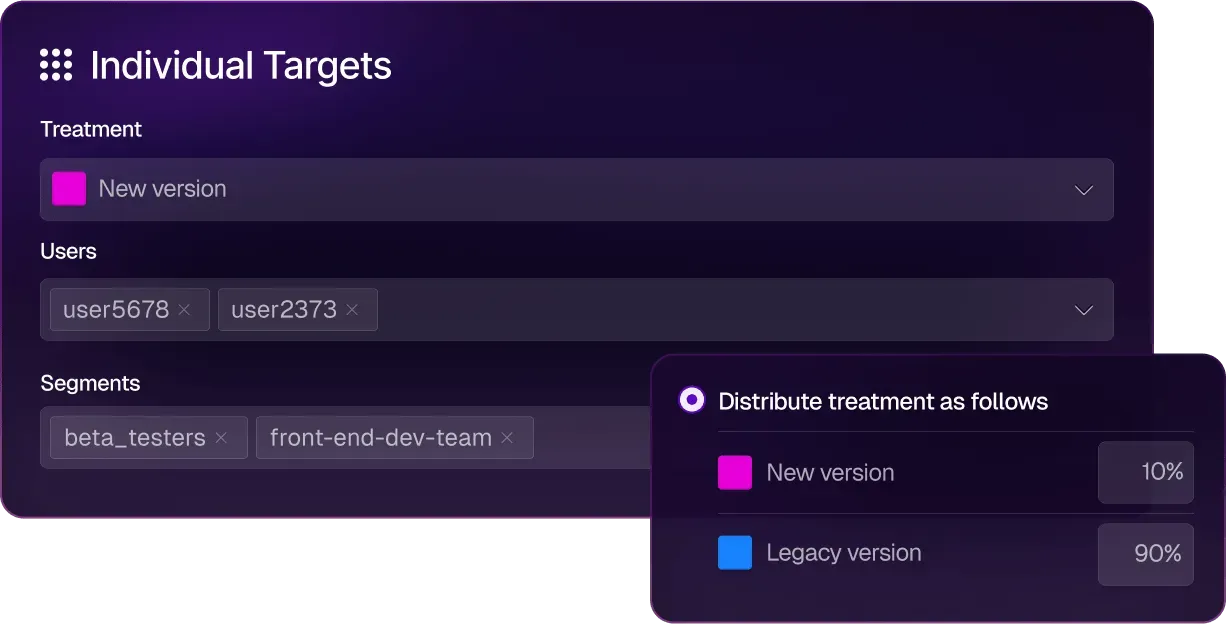
Harness is a software delivery platform combining CI/CD, feature management, security features to improve developer experience. It is much more on DevOps and the entire software delivery lifecycle than the other alternatives.
Split, a feature flags and experimentation platform that used to be on this list, was acquired by Harness in May 2024.
Key features
CI/CD: Harness provides a modern CI/CD with automations, AI, and reusable templates.
Feature flags: Create, target, and manage feature flags. Enables gradual releases and instant rollbacks.
Release monitoring: Autocapture performance metrics and detect the impact of your flag's rollout.
Alerts: Automatically notify when issues and degradations occur connected to the related flags.
Experimentation: Test the impact of variants on key metrics from any source.
How does Harness compare to LaunchDarkly?
Both Harness and LaunchDarkly have a broad, enterprise focus. The difference is that Harness focuses on DevOps and CI/CD, while LaunchDarkly goes deeper on feature management.
Main differences between Harness and LaunchDarkly
- Harness includes a full CI/CD pipeline, making it a broader DevOps platform. LaunchDarkly is mostly a feature management and release intelligence tool.
- LaunchDarkly has richer feature flag targeting, experimentation, and (via Highlight) full observability – session replay, error monitoring, logs, distributed traces. Harness offers release monitoring and alerting, with the ability to ingest data from external tools like Sentry, Datadog, and Segment.
- LaunchDarkly's Guardian plan adds automated rollback and release monitoring. Harness offers similar automated rollback via its release monitoring capabilities connected to flags.
- Harness's experimentation (powered by Split) is now mature with a real-time analytics engine. LaunchDarkly's stats engine and experiment management UI remain more polished for product teams.
Main similarities between Harness and LaunchDarkly
- Both support feature flags with gradual rollouts, targeting, and instant rollback.
- Both are aimed at enterprise engineering teams with a focus on release safety.
- Both offer alerting and monitoring connected to flag changes.
- Both have broad SDK and API support for integrating into existing workflows.
Why do companies use Harness?
According to G2, reviewers are big fans of Harness because:
Ease of setup: Reviewers appreciate how easy Harness is to set up thanks to their SDKs, guides, and user interface.
More confident releases: The tools Harness provides, like easy feature kill switches, alerts, and monitoring enable reviewers to be confident in their feature releases.
Intuitive interface: Creating a new flag is simple, but Harness maintains the depth more advanced users require as well. Reports are easy to understand.
Bottom line
Because it offers similar feature management features and more on top of being self-serve, Harness makes for a great alternative to LaunchDarkly. For teams needing absolute confidence in their new features, Harness's CI/CD, monitoring, and alerting tools are a big help.
5. VWO
- Founded: 2009
- Similar to: Optimizely, LaunchDarkly
- Typical users: Product managers, engineers, UX designers
- Typical customers: Enterprise B2B and B2C companies optimizing customer experiences
What is VWO?
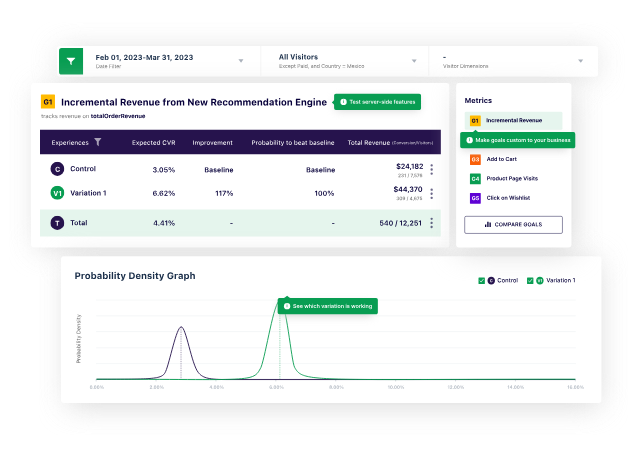
VWO is a digital optimization platform that aims to maximize conversion with tools like A/B testing, personalization, funnels, heatmaps, session replay, and customer analytics.
The VWO platform is home to multiple different products including testing, insights, data, personalize, plan, and web rollouts.
Note: AB Tasty and VWO announced a merger in January 2026 to form a unified digital experience optimization platform. Both products continue to operate independently while the deal closes.
Key features
A/B testing: Improve conversion with web, mobile, and server-side A/B testing.
Data platform: Collect and analyze custom data across your stack.
Insights: Understand your users with session recordings, heatmaps, analytics, and surveys.
Personalization: Create and tailor user journeys and campaigns to the audience, location, and time.
Planning: Ideate and plan optimization campaigns in one location.
How does VWO compare to LaunchDarkly?
Like Optimizely, VWO has a larger feature set than LaunchDarkly, but less of a focus on feature flags specifically. It's a better fit for conversion optimization than engineering-led release management.
Main differences between VWO and LaunchDarkly
- VWO's feature flags are designed for front-end rollouts and web experiments. LaunchDarkly's flags support full-stack targeting with richer lifecycle management.
- LaunchDarkly has enterprise engineering governance: approval workflows, SCIM provisioning, and automated rollback. VWO is an experimentation and CRO tool, not a release management platform.
- VWO targets marketing teams. LaunchDarkly targets engineering and DevOps teams.
Main similarities between VWO and LaunchDarkly
- Both support A/B and multivariate testing with statistical significance.
- Both offer feature flags for progressive rollouts and targeted delivery.
- Both include session replay for understanding user behavior.
- Both target enterprise customers with custom pricing and dedicated support.
Why do companies use VWO?
Reviewers on G2 are big fans of VWO for these reasons:
Support: VWO's support staff are knowledgeable, helpful, and responsive, making a positive impression on reviewers.
Multi-function: Reviewers like they can combine A/B tests with surveys, funnels, session replays, and analysis tools.
Becoming data-driven: VWO enables technical and non-technical to make more and better data-driven decisions.
Bottom line
If you're a massive enterprise looking for all the optimization tools VWO offers, it's a solid alternative. If you are smaller or product-focused, there are likely better options.
6. AB Tasty
- Founded: 2013
- Similar to: VWO
- Typical users: Marketing and product teams
- Typical customers: Large retail and entertainment companies
What is AB Tasty?
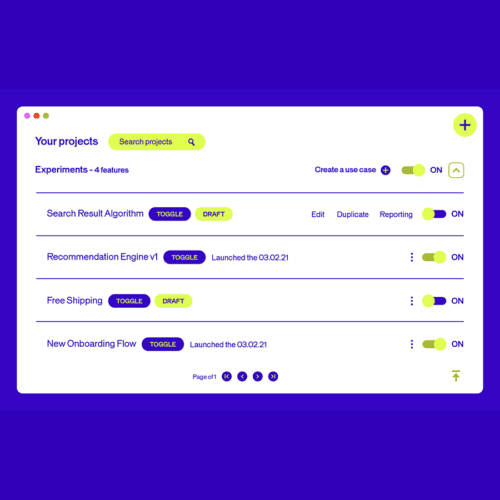
A/B Tasty is a suite of tools for optimizing brand and product experiments. This includes experimentation, personalization, and recommendations. It helps teams build better end-to-end digital user experiences, especially focused on retail, entertainment, and ecommerce.
Note: AB Tasty and VWO announced a merger in January 2026 to form a unified digital experience optimization platform. Both products continue to operate independently while the deal closes.
Key features
Web experimentation: Run A/B and multivariate tests easily with low/no-code tools.
Feature experimentation: Test new features in production for server-side or mobile apps.
Personalization: Create personalized experiences with audience builder and segmentation tools.
Rollouts: Use feature flags to progressively deliver, manage, and rollback new features.
Recommendations: Show the right products at the right time in customers' journey.
How does AB Tasty compare to LaunchDarkly?
AB Tasty has many similar features to LaunchDarkly but lacks the depth. For example, it's missing conversion funnel A/B tests, API evaluation, automation, and more. It makes up for this in the other optimization tools its platform includes.
Main differences between AB Tasty and LaunchDarkly
- AB Tasty is built for marketing and ecommerce experimentation with a no-code visual editor. LaunchDarkly is built for engineering teams with full-stack flag management.
- AB Tasty lacks conversion funnel A/B tests, API evaluation, and enterprise governance features. LaunchDarkly covers all of these.
- AB Tasty includes personalization and product recommendation tools. LaunchDarkly doesn't.
- LaunchDarkly has significantly broader SDK coverage and more mature targeting rules for engineering use cases.
Main similarities between AB Tasty and LaunchDarkly
- Both support A/B and multivariate testing with experiment reporting.
- Both offer feature flags for progressive rollouts and targeted feature delivery.
- Both include personalization and audience segmentation capabilities.
- Both target enterprise customers with custom pricing and dedicated support.
Why do companies use AB Tasty?
According to G2 reviews, users choose AB Tasty for the following reasons:
Ease-of-use: Non-technical users can create and manage simple A/B tests using the visual editor. The reports also praise how simple and intuitive the entire platform is.
Support: AB Tasty's customer support receives high praise. They even provide an option to help you with recommendations and implementation (for a cost) if you need it.
Widgets: Reviewers enjoy AB Tasty's collection of pre-built widgets such as alerts, banners, and modals to help personalize experiences.
Bottom line
A/B Tasty has some useful tools for experience optimization but is missing the depth LaunchDarkly has. If you're a retail and entertainment company, it might be a good alternative, but if not, there are likely better alternatives.
7. DevCycle
- Founded: 2022
- Similar to: Harness
- Typical users: Development teams
- Typical customers: All stages of B2B software companies
What is DevCycle?
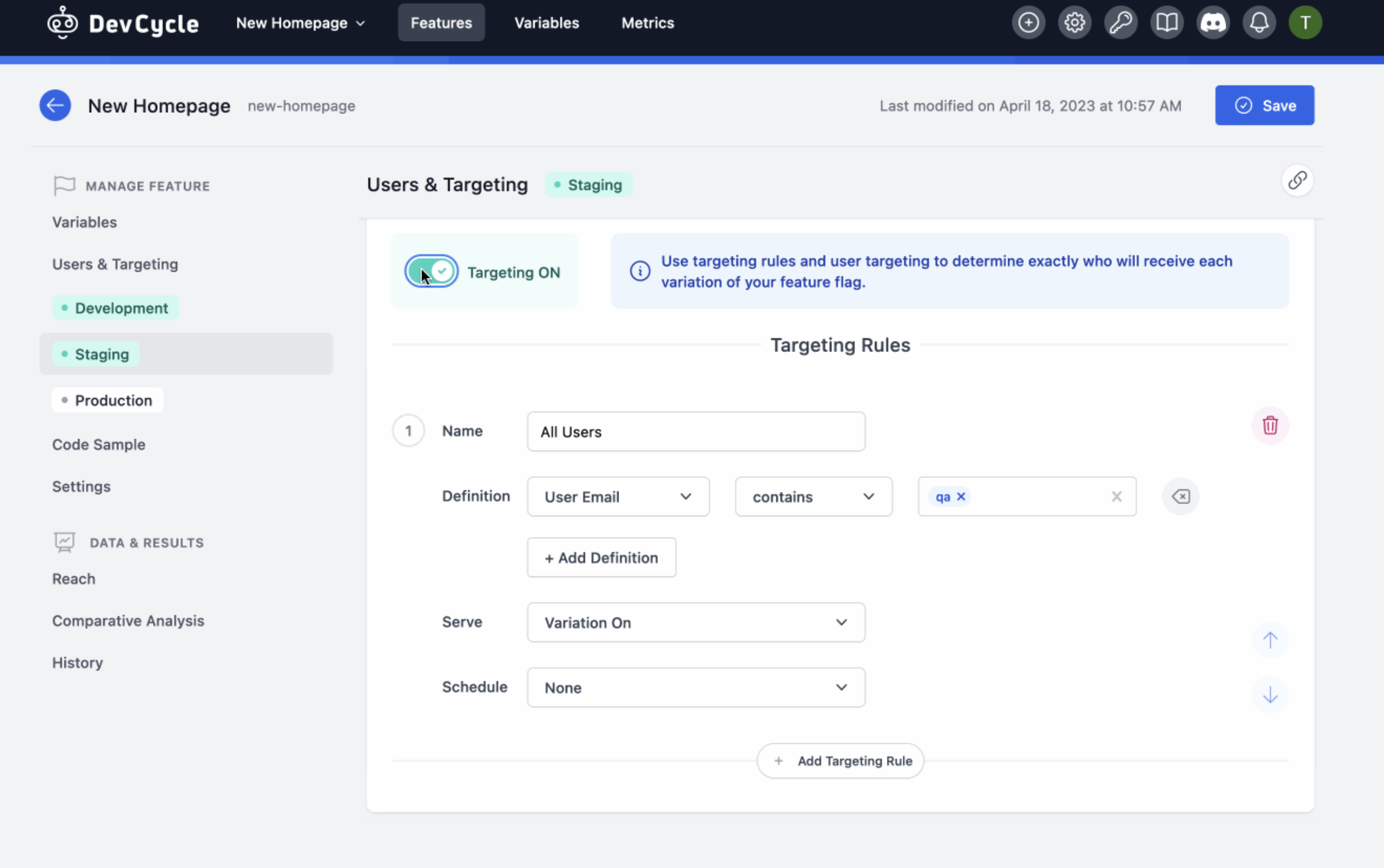
DevCycle is a startup launched out of Taplytics, another A/B testing platform. It is a feature flag management platform built for developers and designed for speed. It highlights its suite of dev tool integrations, CLI, and simple interface.
Note: DevCycle was acquired by Dynatrace in January 2026. Both products continue operating, with DevCycle's feature management capabilities being integrated into Dynatrace's observability platform over time.
Key features
Feature flags: Easily and safely rollout and rollback features to deploy faster and reduce risk. Use automation to put an end to manual changes.
Integrations: Combine with the tools you are already using for your workflow like GitHub, Terraform, Datadog, and Jira.
A/B testing: Run experiments and evaluate the impact of new features. Do multi-armed bandits to compare variations.
Developer-focused: Features like a server-less architecture, edge decisioning support, and a wide API help developers make full use of DevCycle.
How does DevCycle compare to LaunchDarkly?
DevCycle has many of the feature flagging features but misses out A/B testing.
Main differences between DevCycle and LaunchDarkly
- DevCycle focuses on simplicity, OpenFeature compliance, and developer speed. LaunchDarkly has significantly deeper feature flag targeting, lifecycle management, and release governance.
- DevCycle offers approval workflows and SCIM provisioning, but only on Enterprise plans. LaunchDarkly adds automated rollback via Guarded Releases (Guardian plan) – something DevCycle doesn't currently offer.
- DevCycle's experimentation is more limited than LaunchDarkly's. LaunchDarkly has a more mature stats engine and experiment management UI.
- Following its Dynatrace acquisition, DevCycle's roadmap is focused on progressive delivery and automated remediation tied to Dynatrace's observability data – a different direction than LaunchDarkly's Highlight-based observability, which is embedded within the feature management platform itself.
Main similarities between DevCycle and LaunchDarkly
- Both support feature flags with percentage rollouts, user targeting, and instant rollback.
- Both are built for engineering teams with a developer-first SDK experience.
- Both integrate with tools like GitHub, Jira, and Datadog.
- Both offer a free tier for getting started without a sales call.
Why do companies use DevCycle?
According to G2, reviewers appreciate DevCycle's:
Pricing: Unlike other tools listed, DevCycle reviewers praise its fair pricing and say it provides great value.
Simplicity: DevCycle makes it easy for reviewers to get feature flags set up and start improving their feature management process.
Integrations: The fact that DevCycle integrates with GitHub and Jira helps developer workflow.
Bottom line
For developers looking for basic feature flags and experimentation tools, DevCycle is a solid choice. Unfortunately, DevCycle lacks the feature maturity of many of the other options.
Which LaunchDarkly alternative should you choose?
- Want feature flags natively connected to product analytics, session replay, experiments, error tracking, and more? PostHog
- Running a high volume of experiments and want warehouse-native analysis alongside flags? Statsig
- Want feature flags integrated into a full CI/CD and DevOps pipeline? Harness
- Building at an ecommerce or retail company and need web experimentation with personalization? VWO or AB Tasty (they're merging in 2026)
- Need basic, fast, OpenFeature-native flags with observability backing? DevCycle
Is PostHog right for you?
Here's the (short) sales pitch.
We're biased, obviously, but we think PostHog is the perfect LaunchDarkly replacement if:
- You value transparency (we're open source and open core)
- You want more than just experiments and flags (we have a full suite of product analytics, session replays, surveys, and more).
- You want to try before you buy (we're self-serve with a generous free tier)
It's completely free to get started – no credit card required. Our setup wizard handles configuration in minutes, or check out our docs to do it yourself.
Install PostHog with one command
Paste this into your terminal and make AI do all the work.
Frequently asked questions
What is LaunchDarkly used for?
LaunchDarkly is a feature management platform that lets teams safely roll out, target, and manage feature flags across their product. It also includes experimentation (A/B testing), release governance tools like approval workflows and flag scheduling, and – following its acquisition of Highlight in 2025 – session replay and error monitoring tied to release monitoring.
Why do people look for LaunchDarkly alternatives?
The most common reasons are pricing (LaunchDarkly's per-service-connection model is hard to predict at scale), or wanting deeper product analytics alongside flags. Some smaller teams also find LaunchDarkly's features more than they need.
What is the best free LaunchDarkly alternative?
PostHog has the most generous free tier – 1M flag requests, 1M analytics events, and 5,000 session recordings free every month. Statsig and DevCycle also have free tiers.
LaunchDarkly's free Developer tier is limited to 5 service connections and 1,000 MAU, which isn't suitable for a lot of production use cases.
What is the best open-source LaunchDarkly alternative?
Flagsmith and Unleash are open-source options focused specifically on feature flags. GrowthBook is open source and warehouse-native with a strong experimentation focus.
For a broader comparison, see our guide to the best open-source feature flag tools.
Does LaunchDarkly have session replay?
Yes – LaunchDarkly acquired Highlight in April 2025 and now offers session replay, error monitoring, logs, and distributed traces as part of its observability suite. These features are designed for release monitoring (tying sessions and errors to flag evaluations) rather than general product analytics or user research.
How is PostHog different from LaunchDarkly?
PostHog is an all-in-one platform where feature flags connect natively to product analytics, session replay, error tracking, logs, LLM analytics, and more. LaunchDarkly specializes in feature management and release governance, with deeper approval workflows, flag scheduling, and enterprise compliance tooling.
PostHog is self-serve with transparent pricing; LaunchDarkly's advanced features require an enterprise contract.
How much does LaunchDarkly cost?
LaunchDarkly uses usage-based pricing tied to service connections and client-side MAU.
- The free Developer tier covers 5 service connections and 1,000 MAU.
- The Foundation plan starts at $12/service connection/month plus $10/1,000 client-side MAU/month.
- Enterprise pricing requires contacting sales.
- Experimentation MAU is billed separately at $3/1,000/month on Foundation and above.
What are the best feature flag and A/B testing tools in 2026?
The top feature flag and experimentation tools in 2026 include:
- PostHog – Best all-in-one platform with feature flags, A/B testing, analytics, and more
- LaunchDarkly – Best for enterprise release governance and observability
- GrowthBook – Best open source warehouse-native experimentation platform
- Statsig – Best for high-volume experimentation (now owned by OpenAI)
- Harness – Best for teams wanting flags integrated into a full CI/CD pipeline
- DevCycle – Best for simple, fast, developer-focused feature flags

Subscribe to our newsletter
Product for Engineers
Read by 100,000+ founders and builders
We'll share your email with Substack
PostHog is an all-in-one developer platform for building successful products. We provide product analytics, web analytics, session replay, error tracking, feature flags, experiments, surveys, LLM analytics, logs, workflows, endpoints, data warehouse, CDP, and an AI product assistant to help debug your code, ship features faster, and keep all your usage and customer data in one stack.